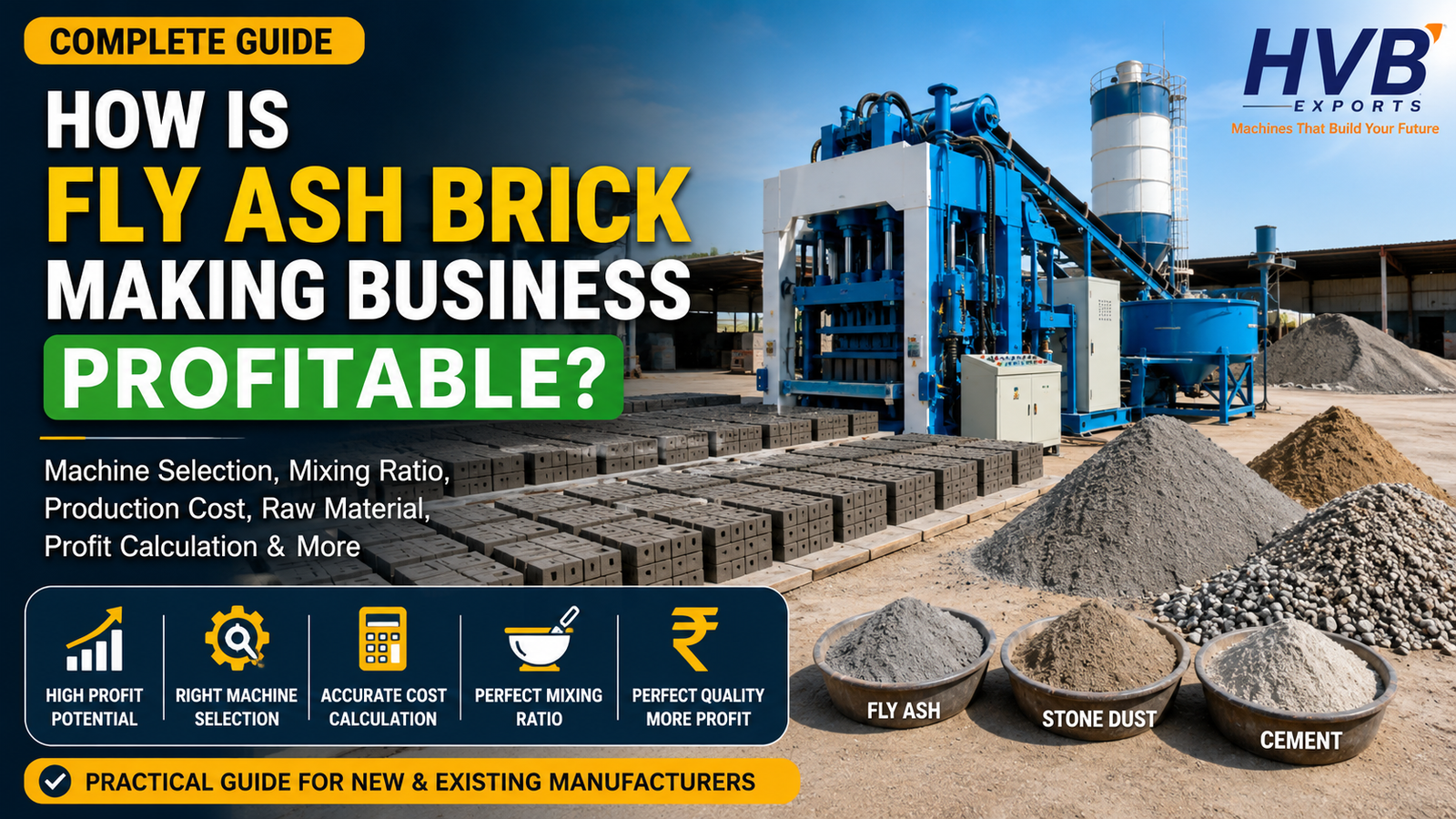
How Is Fly Ash Brick Making Business Profitable?
A practical, ground-level guide to machine selection, production capacity, labour cost, mixing ratio, raw material sourcing and actual brick profitability.
Yes, fly ash brick making can be a profitable manufacturing business. But buying a machine and producing bricks does not automatically guarantee profit.
Your real profitability depends on local demand, machine selection, production utilisation, raw material cost, mixing ratio, labour, electricity, transportation and selling price.
7 Things You Must Get Right
Right Machine
Choose capacity according to your actual local demand, not just maximum production.
Right Production
Higher production helps only when you can sell the additional bricks.
Mixing Ratio
A consistent mix helps control quality, rejection and material wastage.
Brick Costing
Calculate every major cost before deciding your selling price.
Market Fit
Know which brick size, quality and price your local builders actually want.
Raw Material
Check fly ash availability and its final landed cost at your plant.
Working Capital
Keep enough cash for materials, labour, power, transport and customer credit.
1. Choose the Right Fly Ash Brick Making Machine
Do not select a machine simply because it has a high production capacity.
First ask: How many bricks can I realistically sell per day in my market?
| Situation | What it means |
|---|---|
| Demand: 5,000 bricks/day | A 15,000-brick/day machine may be unnecessarily oversized at the beginning. |
| Demand growing steadily | A machine with room for expansion may make more sense. |
| Low local demand | Focus on market development before investing in very high capacity. |
Compare machine capacity, bricks per stroke, cycle time, hydraulic pressure, electricity requirement, labour requirement and future expansion.
2. Labour Cost Can Change Your Profit
Suppose you have 5 workers × ₹500/day = ₹2,500/day labour cost.
| Daily production | Labour cost per brick |
|---|---|
| 2,500 bricks | ₹1.00 |
| 5,000 bricks | ₹0.50 |
The same ₹2,500 labour expense gets distributed across more bricks as production increases. But again, production should increase only when there is enough demand.
3. Don't Compare Machines Only by Pressure
Hydraulic pressure is important, but it is not the only specification that determines the final brick.
- Hydraulic pressure and consistency
- Mould design and brick dimensions
- Pressing quality and density
- Cycle time and production consistency
- Hydraulic system and maintenance
- Electricity and labour requirement
Ultimately, focus on the quality and consistency of the bricks produced, not only a pressure number shown in a specification sheet.
4. Get the Mixing Ratio Right
Mixing ratio directly affects brick quality, production cost and material wastage. A ratio that works well with one source of fly ash may not perform identically with another.
Another practical problem is that ratios are often given in percentages or parts, while workers at the site commonly measure materials using a ghamela.
🧮 Convert Ratio to Ghamela Quantities
Enter your mixing ratio and the weight/capacity of one ghamela to get practical quantities for the batch.
Open Mixing Ratio Calculator →5. Calculate Your Actual Cost Per Brick
Your actual manufacturing cost is more than raw materials.
Fly ash, dust/sand, cement and water.
Labour, electricity and machine maintenance.
Land/rent, pallets, depreciation and overheads.
Loading, unloading, transportation, rejection and credit costs.
📊 Calculate Brick Cost & Profit
Use your own raw material rates, labour, electricity, production and selling price instead of relying on somebody else's project report.
Calculate Your Cost & Profit →6. Fly Ash Availability & Landed Cost
Fly ash is a high-volume, relatively low-value material, so transportation can strongly affect the economics.
Don't look only at the purchase price at the power plant. Calculate the landed cost at your factory after transportation and handling.
Likewise, don't blindly assume that fly ash must be below a particular per-ton price. Compare the final delivered cost, quality and reliability of supply.
7. Market Demand Is More Important Than Machine Capacity
Imagine your machine can produce 15,000 bricks/day, but your market can absorb only 5,000 bricks/day.
Before investing, speak with builders, contractors, hardware dealers, building-material suppliers and project contractors. Find the actual selling price, demand and payment cycle in your area.
Before Investing, Calculate These 9 Numbers
- Realistic daily sales
- Machine capacity required
- Labour cost per brick
- Landed fly ash cost
- Mixing ratio and material consumption
- Actual manufacturing cost per brick
- Realistic selling price
- Working capital requirement
- Profit at 50%, 75% and 100% production utilisation
Final Takeaway
Fly ash brick manufacturing can be profitable, but profitability comes from controlling the complete system.
Don't start with the machine. Start with the numbers.
Youtube click here